
How to Calculate Tube Feeds (and Feel Confident Doing It)

-
· Tube feeding math follows consistent formulas. Once you understand the terminology, the calculations become predictable and manageable.
· Total Daily Volume is the starting point for most calculations. From there, you divide by hours (for continuous feeds) or number of feeds (for bolus feeds).
· Continuous feeding rate formula:
Total Volume ÷ Feeding Hours = mL per hour (mL/hr).· Bolus feeding dose formula:
Total Daily Volume ÷ Number of Feeds = mL per feed.· Gravity feeding formula:
(Volume × Drop Factor) ÷ Time (in minutes) = Drops per minute.
Always confirm the drop factor printed on your tubing.· Flush volumes add up over 24 hours. Multiply the flush amount by how many times it’s given per day to calculate total daily flush volume.
· Small rounding differences can affect the total delivered over time. Always confirm rounding guidance with your care team.
· Writing out formulas, using a calculator, and double-checking changes with your dietitian builds confidence and reduces errors.
When in doubt, ask your healthcare provider or DME team. Clarifying questions are part of safe tube feeding care.
Calculating tube feeding rates can feel intimidating at first. Between milliliters, hours, rates, doses, and drip chambers, it’s easy to worry about getting something wrong.
The good news - once you understand the terminology and follow a simple step-by-step process, tube feeding math becomes predictable and manageable. This guide walks you through the key terms, shows you how to calculate continuous, bolus, and gravity feeds, and includes example calculations for each section so you can feel confident doing it at home.
Understanding the Key Terminology
Before calculating anything, it’s important to understand what you’re solving for.
Rate (mL/hr)
What it means: The amount of formula delivered per hour.
Where you see it: On feeding pump settings.
How it’s calculated: Total Volume in mL ÷ Hours = Rate (mL/hr)
Example: 1,200 mL ÷ 20 hours = 60 mL/hr.
What happens: The pump will deliver 60 milliliters every hour.
Dose (mL per feed)
What it means: The amount of formula given at one time or at each feeding, typically used when individuals receive multiple feedings throughout the day.
How it’s calculated: Total Daily Volume in mL ÷ Number of Feeds = Dose.
Example: 1,200 mL ÷ 4 feeds = 300 mL per feed.
Total Daily Volume (mL/day)
What it means: The total amount of formula prescribed in a 24-hour period. This number is usually written directly in the feeding order and serves as the starting point for most calculations. Your DME provider uses this amount to determine how many cartons of formula to ship every month.
Example: “Provide 1,500 mL per day.”
Continuous Feeding
Formula delivered slowly and steadily over several hours using a feeding pump. You calculate a rate in mL/hr. Most continuous feeds run for 12-24 hours.
Bolus Feeding
A larger volume given over a shorter amount of time multiple times per day using a syringe, gravity bag, or sometimes a pump over a short period. You calculate the dose per feed.
Drop Factor (drops/mL)
Used in gravity feeding. This is how many drops equal 1 mL. The number is printed on the tubing package (commonly 15 drops/mL or 20 drops/mL). Different brands vary, so always check your specific tubing.
Drops Per Minute (drops/min)
Used during gravity feeding. This is how many drops you count in the drip chamber per minute to deliver the correct amount over the desired timeframe.
Understanding these terms makes the math easier because you know exactly which number you are solving for.
How to Calculate a Continuous Tube Feeding Rate
Continuous feeds run at a steady rate over a set number of hours.
Step 1: Identify Total Daily Volume
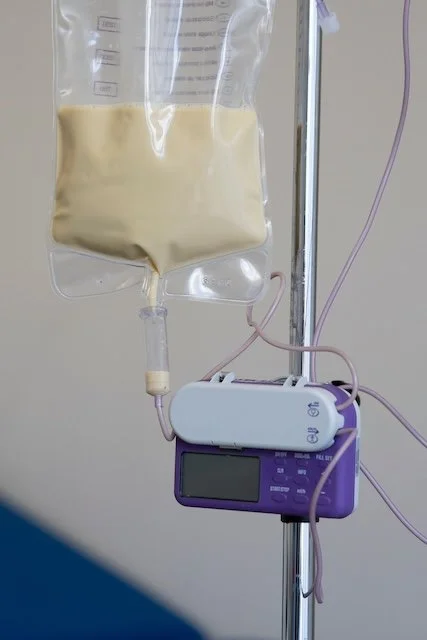
Example order: “Provide 1,200 mL per day.”
Total Daily Volume = 1,200 mL.
Step 2: Identify Feeding Hours
Feeds run 20 hours per day to allow for breaks.
Feeding Time = 20 hours.
Step 3: Calculate the Rate
Formula: Total Daily Volume in mL ÷ Feeding Hours = Rate (mL/hr).
1,200 mL ÷ 20 hours = 60 mL/hr.
Step 4: Program the Pump
Set the pump rate to 60 mL/hr.
Continuous Example #2
Order: 1,500 mL over 18 hours.
1,500 mL ÷ 18 hours = 83.3 mL/hr.
Most pumps use whole numbers. Always confirm rounding instructions with your care team. In many cases, this would be rounded to 83 mL/hr.
How to Calculate Bolus Tube Feeds
Bolus feeds divide the total daily volume into multiple feedings.
Step 1: Identify Total Daily Volume
Example: 1,200 mL per day.
Step 2: Identify Number of Feeds
4 feeds per day.
Step 3: Calculate Dose Per Feed
Formula: Total Daily Volume in mL ÷ Number of Feeds per day = Dose.
1,200 mL ÷ 4 feeds = 300 mL per feed.
Each feeding will be 300 mL. Your provider will specify how long each bolus should take (for example, 15–30 minutes).
Bolus Example #2
Order: 1,800 mL per day, given 6 times per day.
1,800 mL ÷ 6 times a day = 300 mL per feed.
The formula amount stays consistent every time.
How to Calculate a Gravity Feeding Rate
Gravity feeding does not use a pump. Instead, you manually control the rate using a roller clamp and measure drops per minute.
You need three pieces of information: volume (mL), time (minutes), and drop factor (drops/mL).
Step 1: Convert Time to Minutes
Example: 300 mL over 30 minutes with tubing labeled 20 drops/mL.
Step 2: Use the Formula
Formula: (Volume × Drop Factor) ÷ Time (minutes) = Drops per Minute.
(300 ml × 20 drops/mL) ÷ 30 minutes = 6,000 drops ÷ 30 minutes = 200 drops per minute.
Adjust the roller clamp until you count about 200 drops in one minute.
Gravity Example #2
240 mL over 45 minutes with tubing labeled 15 drops/mL.
(240 mL × 15 drops/mL) ÷ 45 minutes = 3,600 drops ÷ 45 minutes = 80 drops per minute.
Always confirm the drop factor printed on your tubing.
Emergency Gravity Feeding (Power Outages)
If your pump loses power, you can temporarily switch to gravity feeding. Use a gravity feeding bag, confirm the drop factor, calculate drops per minute, count drops for a full 60 seconds (1 minute), and recheck periodically to ensure the rate stays consistent. Keeping common calculations written in your care binder can make emergencies less stressful.
Calculating Water Flush Totals
Flushes help prevent clogs, maintain hydration, and clear tubing of feeding equipment.
Bolus Flush Example
Order: “Flush 60 mL before and after each feed.”
4 feeds per day.
Before feeds: 60 mL × 4 = 240 mL.
After feeds: 60 mL × 4 = 240 mL.
Total daily flush volume: 240 mL + 240 mL= 480 mL.
Continuous Flush Example
Order: “Flush 120 mL every 4 hours.”
There are 24 hours in one day. Divide 24 hours by 4 to get the number of flushes per day. 24 hours/4 hours = 6 flushes. 120 ml x 6 flushes = 720 ml total water per day from flushes
Sometimes, your dietitian or provider will let you skip the overnight flush. If they do, then given 5 flushes per day: 120 × 5 = 600 mL total water per day from flushes.
Your care team will clarify whether flushes count toward total hydration goals.
Common Mistakes & How to Avoid Them
Mixing up mL and ounces. Feeding orders are almost always written in milliliters. There are 30 mL in 1 fluid ounce.
Forgetting to calculate based on actual feeding hours. If feeds pause for school or therapy, you will need to adjust accordingly.
Using the wrong drop factor in gravity feeding. Always check the tubing package.
Rounding incorrectly. Small changes can affect 24-hour totals.
Not asking for clarification. If something feels confusing, ask your care team.
Tips to Feel More Confident
Keep a care binder with written calculations
Use a calculator every time
Write out the formula before solving
Double-check changes with your dietitian
Save trusted enteral feeding calculators for backup
Practice builds confidence. Most caregivers find that after doing the math a few times, it becomes routine.
Helpful Resources to Help Calculate Enteral Feeding Rates
Even when you understand the math, having a reliable tool to double-check your calculations can bring extra peace of mind.
Tubie Tech Enteral Feeding Calculator: A free online calculator that helps you determine:
Continuous feeding rates (mL/hr)
Bolus doses
Adjusted feeding schedules
This is helpful when feeding hours or total daily volume change. Always compare results with your provider’s written order.
Moog Infinity Pump Calculator: Designed for families using the Infinity feeding pump, this tool helps confirm:
Rate (mL/hr)
Total volume
Duration settings
It’s especially useful when adjusting pump schedules or transitioning between feeding plans.
Emergency Gravity Feeding Print Out: An emergency gravity feeding reference is a quick guide that helps you calculate drops per minute if your feeding pump is unavailable during emergencies such as a power outage or pump malfunction. Having pre-written formulas and common calculations in your care binder can reduce stress and help you respond quickly.
This resource is especially helpful when:
There is a power outage
Your pump battery dies
The pump alarms or stops working
You are waiting for replacement equipment
You need a temporary backup feeding method
By keeping your child’s typical volumes, feeding times, and tubing drop factor written down in advance, you can safely transition to gravity feeding without having to calculate from scratch in an urgent moment.
Your Care Team: Online calculators are helpful, but your dietitian or DME team can guide you with changes to volume, rate, or schedule. When in doubt, ask. Double-checking is part of safe care.
When to Reach Out for Help
Contact your healthcare provider or DME team if:
Feeding volumes change
You’re unsure how to adjust a rate
Your pump alarms frequently
Gravity feeds are running too fast or too slow
You feel unsure or uncomfortable with calculations
At Sentido Health, our team supports families beyond supplies. If you’re new to tube feeding or need guidance reviewing your feeding plan, we’re here to help you feel confident in your care.
Reach out to our team to learn how Sentido can support your family with enteral feeding supplies and education.
Always follow the feeding plan provided by your healthcare provider or dietitian. This article is for education and confidence-building purposes only and does not replace medical advice.